



Measles outbreak: A preventable disease finding a new foothold
Measles is preventable with vaccination, but the recent measles outbreak in the United States of America is showing that it is spreading again, especially among unvaccinated people.
96% of total cases to date in 2026 are among unvaccinated or unknown-status individuals.
Measles outbreak CDC USA Data-
| 2026 To date | 2025 Full Year | |
| Total cases | 4588 | 2289 |
| AGE | ||
| Under 5 years | 766 ( 17%) | 584 (26%) |
| 5-19 years | 1914 (42%) | 1018 (44%) |
| 20+ years | 1881 (41%) | 674 (29%) |
| Age unknown | 27 (1%) | 13 (1%) |
| VACCINATION STATUS | ||
| Unvaccinated or unknown | 96% | 93% |
| One MMR dose | 2% | 3% |
| Two MMR doses | 2% | 4% |
What this data suggests-
The number of unvaccinated or unknown-status patients is increasing compared to 2025.
479 people needed hospitalization this year so far, compared to 244 in 2025.
This data suggests that measles has spread aggressively this year compared to last year, and unvaccinated people are at greater risk compared to vaccinated people.
Why did this outbreak occur?
When more than 95% of the people in a community are vaccinated, most of the people in that community are protected through community immunity (also known as herd immunity).
Vaccination coverage among U.S. kindergartners has decreased from 95.2% during the 2019-2020 school year to 92.4% in the 2025-2026 school year, leaving approximately 280000 kindergartners at risk during the 2025-2026 school year.
When measles gets into the communities of unvaccinated people in the United States, an outbreak can occur.
When and why campaign against vaccination started?
In 1998, a report was published that falsely hypothesized that MMR vaccines may cause a syndrome of autism and intestinal inflammation.
After the publication of this report, vaccination coverage in the United Kingdom diminished.
In the report, a small case series was published examining just 12 children who had chronic enterocolitis (bowel inflammation) and a developmental disorder (9 of whom had autism).
In 8 out of those 12 cases, parents noted that the developmental delay began around the same time their child received the MMR vaccine.
This simple timing overlap was wrongly presented as a causal link by the study’s lead author, the public, and parts of the media.
The widespread public attention led to decreased vaccine coverage.
Subsequent comprehensive reviews and large-scale epidemiological studies have thoroughly disproven and refuted any link between the MMR vaccine and autism.
Measles
Measles virus
It is a spherical, non-segmented, single-stranded, negative-sense RNA virus.
It is a highly contagious pathogen transmitted directly.
Family: Paramyxoviridae.
Who are at high risk?
Transmission is common among household contacts, school-aged children, and health care workers.
Newborns become susceptible to the virus when antibodies acquired from the mother are lost, and the baby is unvaccinated.
Immunocompromised individuals are also at high risk.
Unvaccinated individuals are at higher risk.
What time of the year is measles most common?
In temperate climates, annual measles outbreaks typically occur in the late winter and early spring.
These annual measles outbreaks can be attributed to social networks facilitating transmission (such as during the congregation of children at school) and environmental factors favouring the transmission of measles virus.
Measles incubation period:
The incubation period is 10 days to fever onset and 14 days to rash onset.
This period can be shorter in infants and longer (around 3 weeks) in adults.
How does the measles virus spread in our body?
Infection starts when the virus enters the body and gets deposited in the respiratory tract, oropharynx, or conjunctivae.
During the first 2-4 days after infection, the virus starts to proliferate (rapidly increases in number) locally in the respiratory mucosa, primarily in dendritic cells and lymphocytes, and spreads to draining lymph nodes.
After this, the virus enters the bloodstream, producing primary viremia, which spreads the virus in the reticuloendothelial system.
Further replication results in secondary viremia that begins 5-7 days after infection and spreads the virus throughout the body.
Signs and symptoms of the disease occur 8-12 days after the infection, and this marks the end of the incubation period.
Management of Measles:
Here we will discuss signs, symptoms, investigations, and treatment options.
Signs and symptoms
Fever and malaise at the beginning, nearly 10 days after exposure.
Headache, abdominal pain, vomiting, and diarrhea may be present.
This is followed by cough, coryza (acute inflammation of the mucous membrane of the nasal cavity), and conjunctivitis.
These signs and symptoms increase in severity for the next 4 days.
Koplik’s spots: These are small bluish-white spots with a red background that develop on the buccal mucosa opposite the lower molars but rapidly increase in number and may involve the entire buccal mucosa. These spots usually appear 2 days before the rash. These spots are 1 mm in size. These spots fade with the onset of the rash.
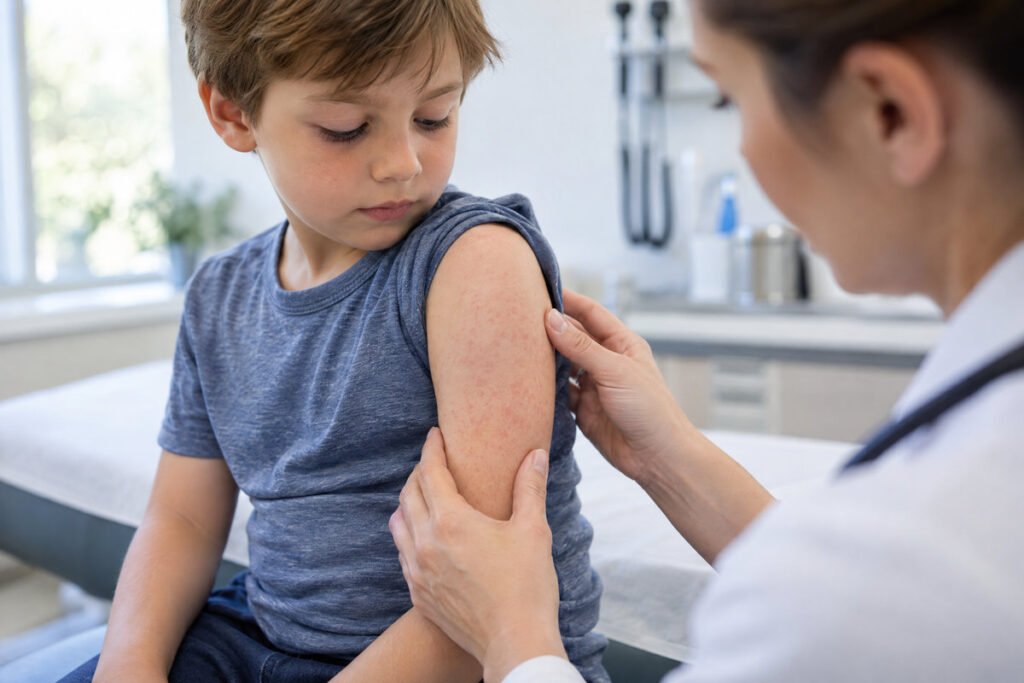
Rash: The rash begins as erythematous macules behind the ears and on the neck and hairline. The rash progresses to involve the face, trunk, and arms. The legs and feet are affected by the second day.
The rash usually fades from the third or fourth day after the onset.
The rash usually appears due to the cellular immune response, and it may not develop in persons with impaired cellular immunity ( such as those with AIDS). These persons have a high case fatality rate.
Diagnosis-
The clinical features described are usually important for diagnosis of measles. Koplik’s spots are especially helpful.
Serology tests are the most common laboratory method to detect the virus. The detection of measles-specific IgM antibodies from the serum or oral fluids is considered diagnostic.
The virus can also be diagnosed by isolating the virus through cell culture from nasopharyngeal secretions, respiratory secretions, blood, or urine.
Treatment:
No specific antiviral therapy is approved for measles treatment.
Supportive treatment, such as antipyretics to control fever and maintenance of hydration, is important.
Secondary bacterial infection is the major cause of morbidity and mortality. It is important to keep an eye on the signs and symptoms of bacterial infections and start antibiotics to control the infection.
Streptococcus pneumoniae and Haemophilus influenzae are common secondary bacterial infections in measles.
Vitamin A is effective in the treatment of this virus.
Prevention of measles
Passive immunization:
Human immunoglobulin given shortly after exposure can attenuate the clinical course of the disease. Prophylaxis with immunoglobulin is given to susceptible household or nosocomial contacts who are at risk of developing the disease, especially children less than 1 year of age, immunocompromised patients, and pregnant women.
Active immunization:
Antibodies first appear 12 to 15 days after vaccination, and the titer peaks at 1-3 months.
This vaccine is often combined with other vaccines such as Mumps and rubella. It is known as the MMR vaccine.
The first dose is given at 12 to 15 months of age.
The second dose is given at 4 to 6 years of age.